Bun
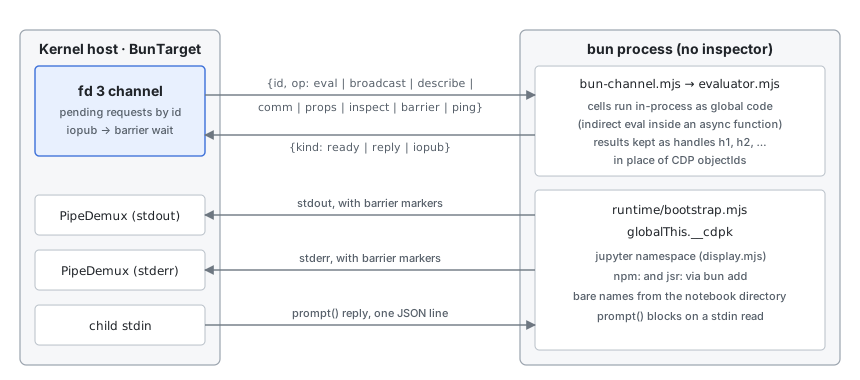
Bun runs JavaScript on JavaScriptCore, not V8, and its --inspect speaks the WebKit Inspector Protocol instead of CDP. That protocol lacks the three things the Node and Deno integration is built on: replMode (top-level await and re-declarable let/const), Runtime.addBinding (messages from the target), and Runtime.terminateExecution (interrupts). So the Bun target doesn't use an inspector at all. The host and Bun exchange JSON lines over a private pipe, and cells are evaluated inside Bun by a small evaluator.
The code is in src/bun-target.ts (the host side, BunTarget), runtime/bun-channel.mjs (the pipe, in Bun) and runtime/evaluator.mjs (the evaluator, shared with workerd and celld). For what all runtimes share, start with Runtime integrations.
Launch
bun runtime/bootstrap.mjsThe host spawns this with four pipes: stdin, stdout, stderr, and a fourth on file descriptor 3, which becomes the channel. There are no flags. Bun reads the notebook directory's bunfig.toml and package.json on its own, and auto-installs bare imports when there's no node_modules.
bootstrap.mjs is the same entry module Node and Deno load. It detects Bun (globalThis.Bun), sets up the shared __cdpk shim and jupyter namespace, then starts the channel and sends { "kind": "ready", "versions": { ... } }. The host waits for that line before running the first cell. Anything Bun prints to stderr before that line is held back, then passed on; if Bun exits instead, it goes into the launch error, since it's usually the reason.
The channel has no port and no URL: only the host holds the other end of fd 3, so nothing else on the machine can reach the target.
The channel
Each line on fd 3 is one JSON object. The host sends requests:
{ "id": 7, "op": "eval", "code": "var x;\n(async () => { ... })()" }Bun answers each with a reply carrying the same id, in whatever order they finish:
{ "kind": "reply", "id": 7, "result": { "type": "object", "objectId": "h3" } }or, if handling the request threw, { "kind": "reply", "id": 7, "failure": "<stack>" }. Between replies, display() and the other display functions send { "kind": "iopub", ... } and { "kind": "input_request", ... } lines, the same messages the CDP binding carries on Node and Deno.
The requests mirror the CDP calls the kernel makes of the other targets:
op | Does | CDP equivalent |
|---|---|---|
eval | Runs a transformed cell | Runtime.evaluate |
broadcast | Formats a result handle as execute_result | callFunctionOn(__cdpk.broadcastResult) |
describe | Name, message and stack of an error handle | callFunctionOn(__cdpk.describeError) |
comm | Delivers a frontend comm message | callFunctionOn(__cdpk.commDispatch) |
props | Property names for completion | Runtime.getProperties |
inspect | Text for Shift+Tab | callFunctionOn(__cdpk.describeForInspect) |
barrier | Writes a barrier marker, returns its number | Runtime.evaluate(__cdpk.barrier()) |
ping | Answers at once | none; used by interrupts |
Bun writes to fd 3 synchronously (fs.writeSync, retrying on EAGAIN), like a CDP binding call. That keeps a message's position relative to the console.log calls around it, which the barrier markers depend on.
When the host goes away, fd 3 reaches end-of-file and Bun exits, so a crashed kernel leaves no orphan behind.
Handles instead of object ids
CDP returns a value as a RemoteObject with an objectId that later calls can refer to. The evaluator imitates this: after an eval, it stores the result (or the thrown error) in a map under a handle such as h3 and returns { type, objectId: "h3" }. A later broadcast or describe request names the handle, and the evaluator takes the value out of the map. The map is cleared at the start of each eval, so values don't pile up across cells. With the same shapes as CDP, src/kernel.ts treats a Bun target exactly like a Node one.
Running a cell without replMode
Without replMode, the evaluator runs cells as global code with an indirect eval. That brings two problems: global code can't use top-level await, and a let or const in one eval isn't visible to the next. The host's transformCellForEval (in src/transform.ts) solves both with the technique tslab and IJavascript use. It declares every top-level name with var in the outer script, which makes it a property of globalThis, and runs the cell's statements in an async function where those declarations become assignments:
// The cell
const { a } = await load();
class K {}
a + 1// What the evaluator runs
var a, K;
(async () => { 'use strict';
({ a } = await load());
K = class K {};
return [a + 1];
})()So:
- Top-level
awaitworks, inside the async function. - Later cells see earlier declarations, as globals. So do closures created in the cell, because they close over the same global binding.
- Re-running a cell works:
varcan be declared again. - The last expression is the cell's value: it becomes
return [value]. The one-element box stops the async function from awaiting a promise value, so a cell ending in a promise shows the promise, as in Deno. - Functions keep their hoisting and are copied to
globalThison entry.
The difference from Node and Deno is that const doesn't stay constant across cells, and these names are global properties rather than lexical bindings. lexicalNames() returns nothing for Bun; completion finds the names on globalThis instead.
Imports are rewritten by acorn as on every target (see Cells and module loading) and go through __cdpk.import. On Bun that resolves:
npm:andjsr:specifiers with the same helpers the Node hooks use, installing withbun addinto~/.cache/cdp-kernel/bun.- Relative paths and URL schemes (
node:,bun:,file:) against the notebook's directory. - Bare package names with
Bun.resolveSyncfrom the notebook's directory, so itsnode_modules, or Bun's auto-install, supplies them.
Bun transpiles any TypeScript file a cell imports itself, enum included.
Output ordering
stdout and stderr are ordinary pipes, as on Node and Deno, and fd 3 plays the binding's part. So the Bun target uses the same barrier markers and the same PipeDemux and Gates classes from src/target.ts. See Output ordering.
prompt() works as on Node: the target sends an input_request over fd 3 and blocks on a read of stdin until the host writes the reply.
Completion and inspection
V8's throwOnSideEffect has no equivalent here, so the evaluator avoids running user code another way. For obj.<Tab> and Shift+Tab it resolves a dotted path such as a.b.c one property at a time with Object.getOwnPropertyDescriptor, walking up prototypes, and stops at an accessor instead of calling it (resolvePath in runtime/introspect.mjs). Completion on an expression that isn't a plain path returns nothing.
Interrupts
There is no way to stop JavaScript that's running in Bun from outside. The host tells the two cases apart with a ping request:
The cell is waiting (on a timer, a fetch, a promise). Bun's event loop is free, so the ping is answered at once. The host rejects the cell's pending
evalwithInterrupted, and the cell's output ends there. Bun and every global stay as they are. Whatever the cell started keeps running, so its later output can still appear.The cell is busy (
while (true) {}). The ping isn't answered within 500 ms, so the host kills Bun withSIGKILL. The cell's output says:[cdp-kernel] bun was busy and can't be interrupted in place, so it was stopped; it restarts on the next cell, without the earlier cells' stateThe next cell starts a new Bun.
See Interrupts for a diagram.
No debugger
JupyterLab's debugger needs V8's Debugger domain, which only the CDP targets expose, so the Bun kernelspec doesn't advertise one.