Node and Deno
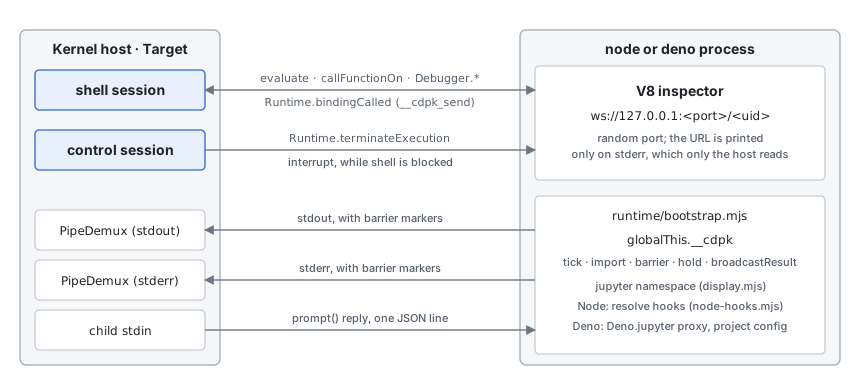
Node and Deno targets are driven the way deno jupyter drives its own REPL isolate: over the Chrome DevTools Protocol (CDP), the protocol behind --inspect and Chrome's DevTools. The host launches the runtime with its inspector on, connects to the inspector's WebSocket, and runs every cell with Runtime.evaluate. The code is in src/target.ts (the Target class), src/cdp.ts (a small CDP client) and runtime/bootstrap.mjs (what the target loads). For what the pieces have in common with the other runtimes, start with Runtime integrations.
Launch
The host spawns one of:
node --inspect=127.0.0.1:0 --inspect-publish-uid=stderr runtime/bootstrap.mjs
deno run --allow-all --node-modules-dir=none --no-lock \
--inspect=127.0.0.1:0 --inspect-publish-uid=stderr runtime/bootstrap.mjs(launchCommand in src/target.ts.) Each flag has a reason:
--inspect=127.0.0.1:0binds the inspector to loopback on a free port, so several kernels never collide.--inspect-publish-uid=stderrkeeps the inspector's URL private. CDP has no authentication: whoever holds the WebSocket URL can run code in the target. By default the inspector also lists the URL athttp://127.0.0.1:<port>/json/list, where any local process could read it. With this flag the URL, which ends in a random UUID, appears only on the target's stderr, and only the host reads that pipe.- Deno:
--node-modules-dir=none --no-lock. Deno looks for a config file next to the main module, which is this package.nonegives the global-cache behaviourdeno jupyterhas in a plain directory, and--no-lockstops Deno from writing adeno.lockinto the package. - Node: the binary. Under a Node host, the target is the same
nodeas the host (process.execPath). Under a Deno host it isnodeonPATH.
The child gets FORCE_COLOR=1 (and no NO_COLOR), so console.log of an object is colored as in a terminal; Jupyter renders ANSI colors.
The host then reads stderr until the ws:// URL appears, connects, and waits for bootstrap.mjs to finish its top-level awaits by polling typeof globalThis.__cdpk?.tick === "function". It records the runtime and V8 versions (shown in kernel_info_reply) and the names of the runtime's own globals, which the debugger's variable view leaves out. If any of this takes over 60 seconds, the host kills the child, closes its sockets, and reports the failure.
The inspector's own notices ("Debugger listening on ...", "Debugger attached.") and Deno's Download https://... progress lines are filtered out of stderr, so they don't show up in the notebook.
Two sessions
The host opens two CDP sessions on the same WebSocket URL:
- shell carries everything ordinary:
Runtime.enable,Runtime.addBinding,Runtime.evaluate,Runtime.callFunctionOn,Runtime.getProperties, and theDebuggerdomain while debugging. It also receives events:Runtime.bindingCalledandDebugger.paused. - control is used for one thing:
Runtime.terminateExecution. While a cell runs, the shell session is waiting on itsRuntime.evaluate, so an interrupt needs a session that isn't.
Running a cell
The host transforms the cell with transformCell (esbuild strips types, acorn rewrites import/export; see Cells and module loading) and adds two lines:
'use strict'; await __cdpk.tick();
// ...the cell...
;let __cdpk_settled = await __cdpk.tick();
It then sends:
{ "method": "Runtime.evaluate",
  "params": { "expression": "...", "contextId": 1, "replMode": true, "awaitPromise": true } }
replMode is the inspector feature Chrome's console and Deno's REPL use. It allows top-level await, and lets let, const and class declarations live on between evaluations and be declared again, as when you re-run a cell. It is why Node and Deno need no hoisting tricks.
The two added lines solve problems with that call:
- The leading tick yields one macrotask, so the cell runs as an ordinary task rather than inside the inspector's dispatch of
Runtime.evaluate. Inside that dispatch the inspector reads no other message, so an interrupt would wait until a busy loop ended. - The trailing tick lets the script settle with nothing queued ahead of the inspector's own callback. The inspector holds the result promise only weakly until that callback runs; a garbage collection in between fails the call with "Promise was collected" (#55). A declaration has no completion value, so the cell's value is unchanged.
The reply is a RemoteObject or exceptionDetails. The host then:
- On an exception, calls
__cdpk.describeError(e)withRuntime.callFunctionOnto get the name, message and stack, and publishes anerrormessage. - Otherwise, unless the value is
undefined, calls__cdpk.broadcastResult(count, value)the same way. This runs in the target, wheredisplay.mjscan call the value's display hooks, and sendsexecute_resultthrough the binding. - Calls
flush(): one__cdpk.barrier()evaluation, then waits until both pipes and every pending message have caught up to that barrier. Only then does it sendexecute_reply.
Calls that return a promise go through __cdpk.hold(), which keeps the promise referenced until a macrotask after it settles, for the same garbage-collection reason as the trailing tick. Calls that return a plain value use plain Runtime.evaluate or callFunctionOn without awaitPromise, for the same reason (#50).
Messages back to the host
Runtime.addBinding({ name: "__cdpk_send" }) installs a function globalThis.__cdpk_send in the target. When code calls it with a string, the inspector fires Runtime.bindingCalled on the shell session with that string as the payload. bootstrap.mjs sends two kinds of message this way:
{ kind: "iopub", msg_type, content, metadata, buffers, barrier }:display_data,update_display_data,execute_resultand comm messages, published by the host on iopub as they are.{ kind: "input_request", prompt, password, barrier }:prompt(),confirm()and password input.
Every message carries a barrier number, and the target writes the matching marker to stdout and stderr just before sending it. The host's PipeDemux uses the markers to keep pipe output and messages in order. Output ordering shows how.
Synchronous input
prompt() must return a string synchronously, as in a browser and in Deno. The target sends an input_request through the binding, then blocks on a byte-at-a-time readSync of its own stdin until a newline arrives. The host forwards the request to the frontend on the stdin socket and writes the reply to the child's stdin as one JSON line, {"value":"..."}, or {"value":null} if the frontend has no stdin or the user cancelled. The host always answers exactly once, so the read returns.
Completion and inspection
Neither completion nor Shift+Tab inspection should run user code: typing obj. must not call a getter that changes state.
- Properties (
obj.<Tab>):Runtime.evaluateof(obj)withthrowOnSideEffect: true, so V8 refuses to run anything that writes, thenRuntime.getPropertieson the result. - Names (
<Tab>at the top level):Runtime.globalLexicalScopeNamesfor the cells'let,constandclassnames, plus the global object's properties. - Inspection: the same side-effect-free evaluate finds the value, and
__cdpk.describeForInspectformats it.
Interrupts
interrupt() resumes the target first if the debugger has it paused (a paused isolate runs nothing to terminate), sends Runtime.terminateExecution on the control session, and rejects the pending Runtime.evaluate on the shell session. A terminated script never settles the promise the inspector is waiting for, so the host abandons the call and ignores any late reply. The session stays usable, the target keeps running, and every earlier cell's state survives, whether the cell was busy or waiting.
Errors outside a cell
An exception thrown later by a timer or an unhandled promise rejection would end a Node process. bootstrap.mjs registers uncaughtException and unhandledRejection handlers (in Deno, error and unhandledrejection listeners that call preventDefault()) and prints the error to stderr, so it shows up in whichever cell is running, and the kernel survives.
A setInterval keeps the event loop alive between cells.
Node specifics
Module resolution. Code evaluated over the inspector has no module of its own, so Node rejects a bare import() in it. The cell transform turns every import into __cdpk.import(...), which calls import() from bootstrap.mjs. runtime/node-hooks.mjs then registers a synchronous resolve hook (module.registerHooks) that:
- Re-parents imports made from the bootstrap module to the notebook's directory, so
./util.tsand bare package names resolve from where the notebook is. - Handles
npm:name@rangeby installing the package on first use into~/.cache/cdp-kernel/npm, under an alias per request, so two ranges of one package can coexist. Acdp-kernel.lock.jsonpins versions (Writing notebooks). - Maps
jsr:@scope/nameto JSR's npm registry as@jsr/scope__name.
Files a cell imports are loaded by Node itself, which strips TypeScript types but doesn't compile enum and similar syntax (Imported TypeScript files).
The Deno namespace. A kernel installed with --deno-compat sets CDPK_DENO_COMPAT=1, and bootstrap.mjs installs a partial Deno global from runtime/deno-compat.mjs, for notebooks written for deno jupyter.
Deno specifics
Projects. If a deno.json or deno.jsonc is at or above the notebook's directory, the host launches Deno with --config <path> instead of --node-modules-dir=none, so the project's import map, nodeModulesDir and other settings apply as in deno jupyter. Its compilerOptions for JSX and decorators are passed to esbuild for the cell transform (src/deno-config.ts). A config that can't be read is reported in the first cell, and the kernel runs without it.
Resolution. Deno resolves npm:, jsr:, URLs and import maps itself. bootstrap.mjs only resolves relative specifiers against the notebook's directory first, since Deno would otherwise resolve them against bootstrap.mjs. In a project, a bare name that Deno can't place is retried from the project's node_modules (runtime/node-modules-resolve.mjs): Deno resolves package.json dependencies relative to the importing module, which here is outside the project.
Copied runtime files. Deno ignores a project's import map for modules loaded from under a node_modules directory. When the host was installed from npm, its runtime/ files are in one, so the host copies them out to ~/.cache/cdp-kernel/runtime/ before launching a Deno target.
Deno.jupyter. Outside deno jupyter, Deno.jupyter is a getter that throws. bootstrap.mjs replaces the Deno global with a proxy that answers jupyter with cdp-kernel's own namespace and forwards everything else, so existing notebooks that use Deno.jupyter.display keep working.
The debugger
Because the host already holds a CDP session, JupyterLab's visual debugger works on Node and Deno: src/debugger.ts translates the Jupyter debug protocol to the V8 Debugger domain on the shell session. See Debugger.