Runtime integrations
cdp-kernel runs TypeScript notebooks on Node, Deno, Bun, workerd and celld. This page explains how the kernel is split between the process Jupyter talks to and the runtime that runs your cells, and what every runtime integration has in common. The pages after it describe each integration in detail:
- Node and Deno: driven over the Chrome DevTools Protocol (CDP).
- Bun: a private pipe and an in-process evaluator.
- workerd and celld: a driver Worker and one WebSocket session.
For what each runtime supports from a notebook's point of view, see Runtimes and Known gaps. For how a cell's TypeScript becomes something a runtime can run, see Cells and module loading.
Background: what a Jupyter kernel is
A Jupyter frontend (JupyterLab, VS Code, nbclient) doesn't run code itself. It starts a separate kernel process, using the command in a kernelspec (kernel.json), and hands it a connection file naming five ZeroMQ sockets: shell (requests such as execute_request and complete_request), iopub (output broadcast to every frontend), control (interrupt and shutdown), stdin (input_request for prompt()), and a heartbeat. Every message is a signed JSON envelope; this is the Jupyter wire protocol.
deno jupyter is a kernel built into Deno: one process speaks the wire protocol and evaluates cells in a V8 isolate it owns. cdp-kernel keeps Deno's protocol code but splits it across two processes, so that the runtime evaluating cells can be something other than Deno.
Two processes: the host and the target
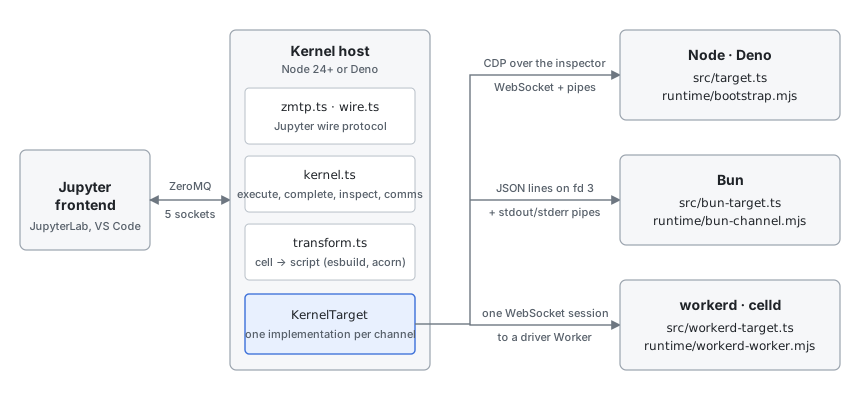
- The kernel host is the process Jupyter starts:
cdp-kernel kernel --runtime <name> --conn <file>(src/main.ts). It runs on Node 24+ or Deno, whichever the package was installed with. It speaks ZMTP and the wire protocol itself (src/zmtp.ts,src/wire.ts; no libzmq), handles each request (src/kernel.ts), and turns cells into scripts (src/transform.ts). - The target is the runtime your cells run in. The host starts it as a child process as soon as the host itself starts, and talks to it through a
KernelTarget(below). The target loads a small set of runtime modules fromruntime/: thejupyterdisplay namespace, comms, widgets and introspection helpers, and a per-runtime entry point.
The host and the target can be different runtimes. A kernel installed from npm has a Node host and can drive a Deno target, and the reverse.
Keeping the protocol in the host means the target only ever runs cell code and a few helper calls. A target that crashes or is killed takes no Jupyter state with it: the host reports the exit in the notebook and starts a new target on the next cell.
The KernelTarget interface
Every integration implements KernelTarget (src/target.ts). The kernel calls nothing else, so this list is the complete contract:
| Member | What the kernel uses it for |
|---|---|
transform(code, options) | Turns a cell into the script evaluate takes. Node and Deno use transformCell; the others use transformCellForEval. |
evaluate(script) | Runs a cell. Resolves to a CDP-shaped EvaluateResult: a result, or exception details. Rejects with Interrupted after an interrupt. |
interrupt() | Stops the running cell (see Interrupts). |
flush() | Resolves once all output and display messages sent so far have been delivered, so execute_reply never overtakes a cell's output. |
broadcastResult(count, result) | Formats a cell's value as execute_result, inside the target, where [Symbol.for("Jupyter.display")] and the other display hooks can run. |
describeError(exception) | Name, message and stack of a thrown value, for the error message. |
dispatchComm(...) | Hands a frontend comm message (widgets) to the target's comm handlers. |
propertyNames(expr), lexicalNames() | Tab completion. |
inspect(path, detail) | Shift+Tab inspection, without running user code. |
debug | The V8 Debugger domain, on Node and Deno only (Debugger). |
replyInput(value) | The frontend's answer to an input_request. |
notice | A line shown once, in the first cell, such as which project's bindings loaded. |
kill() | Stops the target on shutdown or restart. |
The shapes are CDP's even for targets that don't speak CDP: a result is a RemoteObject with an objectId, and an exception arrives as exceptionDetails. On Bun, workerd and celld the objectId is a handle (h1, h2, ...) into a map the target keeps, so the kernel handles every target the same way.
The three channels
Node and Deno expose V8's inspector, which speaks CDP. Driving a runtime over CDP is what deno jupyter does to its own isolate, so that is the default. Two kinds of runtime can't be driven that way:
- Bun. Its
--inspectspeaks the WebKit Inspector Protocol, which has noreplMode, noRuntime.addBindingand noRuntime.terminateExecution. - workerd and celld. Their inspector can evaluate code, but only outside a request, and outside a request a Worker has no I/O: timers,
fetchandcrypto.randomUUID()throw.
So each has its own channel, and cells run in-process instead of through the inspector:
| Node, Deno | Bun | workerd, celld | |
|---|---|---|---|
| Channel | CDP over the inspector WebSocket | JSON lines on a pipe (fd 3) | One WebSocket session to a driver Worker |
| Cells run by | Runtime.evaluate with replMode | Indirect eval of global code | UnsafeEval (workerd) or eval (celld) of global code |
| Output | Pipes + CDP binding, ordered by barrier markers | Pipes + fd 3, ordered by barrier markers | All on the session, already in order |
| Imports resolved by | Node resolve hooks / Deno's loader | bootstrap.mjs, with bun add | The host, which bundles them with esbuild |
| Interrupt | Runtime.terminateExecution; state kept | Ping, else kill and restart | Ping, else kill and restart |
prompt() | Yes, over stdin | Yes, over stdin | Returns null |
| Debugger | Yes | No | No |
What every target shares
- The
__cdpkshim. Each target installs a non-enumerableglobalThis.__cdpkbefore any cell runs. Transformed cells call it (__cdpk.import,__cdpk.meta,__cdpk.tick), and the host calls it (broadcastResult,describeError,commDispatch,barrier). Node, Deno and Bun build it inruntime/bootstrap.mjs; workerd and celld inruntime/workerd-worker.mjs. - The display API.
runtime/display.mjs(a port of Deno's40_jupyter.js) provides thejupyterglobal,display(), MIME bundles andprompt()/confirm(). A target only supplies how to send a message, how to inspect a value and how to read input. - Object-literal wrapping. A cell like
{ a: 1 }is tried as({ a: 1 })first, as Deno's REPL does, and falls back to the code as written. - The first-cell notice. Anything the user needs to know about the launch, such as a Deno or Workers project that failed to load, appears on stderr in the first cell, not only in the server log.
Lifecycle
- Jupyter starts the host with the connection file. The host binds the five sockets and launches the target right away, so the first cell doesn't wait for it. A
kernel_info_requeston the shell socket waits for the launch, so the reply can name the target's runtime and engine versions. - If the target doesn't come up, the failure goes to the server log, and the first cell tries again. If that also fails, the cell ends with a
KernelErrorsaying why. - If the target exits (a crash, or a busy interrupt on Bun, workerd or celld), the host prints why in the notebook and starts a new target on the next cell. Earlier cells' state is gone; Jupyter itself stays connected.
- On
shutdown_requestthe host kills the target and exits. Frontends start a fresh kernel even for a restart.
Output ordering
A cell's output reaches the host by two routes: plain stdout/stderr pipes (console.log, and anything a library writes), and messages (display(), prompt(), comm messages) over the CDP binding or fd 3. The two routes race, so on Node, Deno and Bun the target numbers every message and writes a matching marker to both pipes first:
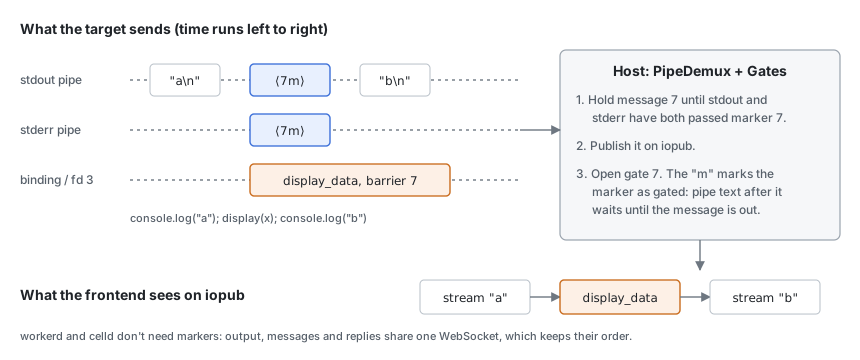
The markers are ESC[cdpk:<n>m]ESC sequences, which PipeDemux in src/target.ts strips out. workerd and celld don't need them: there, console writes into the same WebSocket as everything else.
Interrupts
Jupyter interrupts with an interrupt_request on the control socket (kernelspecs set interrupt_mode: "message"). How the host stops the cell depends on the channel:
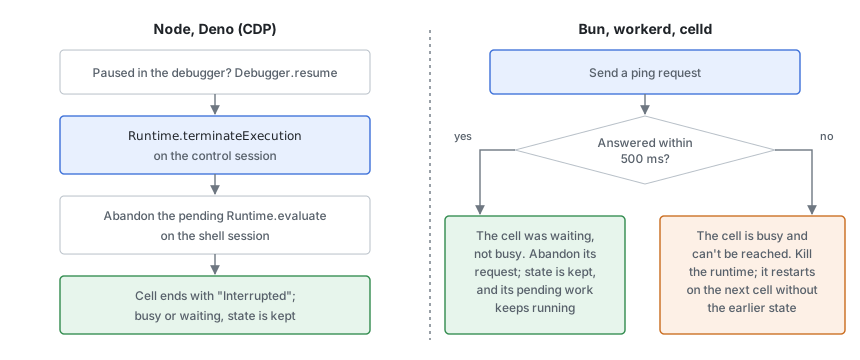
On Node and Deno, a cell starts with await __cdpk.tick(), one macrotask. Without it, a busy loop would run inside the inspector's dispatch of Runtime.evaluate, and the inspector processes no other message until that dispatch returns, so the interrupt would never be read. After the tick, the cell runs as an ordinary task and V8 can terminate it.
On the other targets there is no way to stop JavaScript that is running, so a cell that is still computing costs the runtime and its state. A cell that is only waiting (on a timer, fetch, a promise) is abandoned in place: whatever it started keeps running, and its later output still appears.