Feasibility study: life after deno jupyter
Deno's kernel is two halves joined by thirteen ops, and both halves come apart cleanly. Re-joined over the DevTools Protocol, the same kernel now runs notebooks on Node and on Deno, and on Bun, workerd and celld through backends of their own.
This is the design document the project started from. It was written while cdp-kernel was a spike and revised as the project shipped. The last section compares what it predicted with what was built. For how the kernel works today, read Architecture and Runtime integrations; for current limits, read Known gaps.
Bottom line
Revised 2026-10-16
Deno has since said the runtime stays on a 2.9.x LTS line until October 2027 (What changed), and the weakly held promise issue found after release is fixed. Both, and the current test counts, are folded in below. Each section links to the docs page that now covers its topic in more depth.
Node versions in the study are as of that date. Since 0.6.0 (2026-10-18) the host and the Node target run on Node 22.18 and later, and CI tests Node 22, 24 and 26 (Support policy).
Revision of 2026-10-15
The study was first compiled on 2026-10-14, when cdp-kernel was a spike. It has since been released (@tlockney/cdp-kernel 0.4.0 on npm and JSR), and most of the next steps are done. The verdict held. The sections on the extraction, evidence, options, risks and next steps are updated to the project's state at that date, and Where it landed compares what the study predicted with what was built. The analysis of what changed, the kernel's anatomy, workerd, Bun and rusty_v8 is unchanged except where marked.
Extraction is not only possible; it is done, and released. In June 2026 Deno rewrote its kernel (denoland/deno#34083). The Jupyter wire protocol, ZeroMQ included, is now about 600 lines of plain JavaScript. Execution happens in a separate isolate driven by standard Chrome DevTools Protocol calls. Node, Deno and workerd all expose CDP through --inspect, so the kernel can be pulled apart and pointed at a different runtime.
cdp-kernel does that. It is a port of Deno's protocol half, hosted on Node or Deno, plus the Deno.jupyter display API and a replacement for the parts of Deno's module loader that notebooks lean on: TypeScript, npm: and jsr:. It passes a conformance suite derived from Deno's own Jupyter tests on Node 24 and 26 and Deno 2.9 and the latest 2.x, on Linux and macOS (as of 2026-10-16; Node 22 was added in 0.6.0). A notebook written for deno jupyter, with Polars DataFrames, Vega-Lite, SVG and in-place display updates, gives the same outputs on both.
The other routes rank below it:
- workerd works only with a hybrid design. Timers and I/O are forbidden outside a request. Built: cells run inside one long-lived request (workerd as a target).
- Bun needs its own backend, because it speaks WebKit's protocol rather than CDP. Built: an in-process evaluator over a pipe (Bun).
- rusty_v8 or FFI buys nothing for an evaluator. FFI cannot reach the host's V8 isolate, and a rusty_v8 host means rebuilding most of deno_core.
Recommendation: package cdp-kernel as a standalone, runtime-neutral kernel. Treat CDP as the primary backend. Add backends for Bun and workerd only if you need them.
Outcome: all three were done. The Bun and workerd backends, and a third for celld that reuses the workerd driver, share the host, wire protocol, transformer and display module, as predicted. The CDP targets remain the most faithful; the in-process backends trade some REPL semantics and lose state on a busy-cell interrupt (Risks and gaps).
What changed
Ryan Dahl's post of 2026-10-09 (deno.com/blog/cloudflare) moves the Deno team to Cloudflare.
- The runtime gets about a year of monthly bug-fix and security releases, then development ends. Revised below: that year is a 2.9.x LTS line, running until October 2027.
- Deploy shuts down in six months.
- JSR stays up, with its infrastructure moving to Cloudflare.
- rusty_v8 is the one piece with a stated future: "We will continue supporting rusty_v8 and work toward integrating it into workerd." No timeline is given.
The joint Cloudflare post, by Dahl and Kenton Varda, frames the goal as making self-hosted workerd a first-class way to run Workers apps, with celld folded back in. Neither post mentions deno_core, notebooks, or Jupyter.
Revised: celld is usable now. cdp-kernel gained a celld target on celld 0.6.2, alongside workerd.
Revised 2026-10-16: the Deno team's state of Deno (denoland/deno#37030, 2026-10-15) makes the year concrete:
- a 2.9.x LTS release every month, with bug fixes and security updates, until October 2027;
- no new features: feature pull requests are closed, and canary-only features are reverted so
mainmatches 2.9; - well-written bug-fix pull requests are still reviewed and merged.
It doesn't mention deno jupyter. For cdp-kernel this settles what the Deno target is: a fixed target. Deno 2.9's kernel, module loader and Deno.* APIs won't change under it, and the CI matrix's "Deno 2.9" and "latest 2.x" should in practice test the same line. After October 2027 the Deno target is only as alive as whichever fork carries the runtime on.
On the community side, denoland/deno#36995 collects fork announcements: rjs, dodo, and one maintainer's planned conservative fork. Nobody has claimed the Jupyter kernel. The existing Node kernels are stale: tslab last released in mid-2024, IJavascript in 2021, and both depend on the native zeromq addon.
Sourcing
The announcement terms come from the Deno post, which was read directly. The fork names, the Cloudflare post's wording, and the kernel release dates come from a research sweep and were not re-checked, so treat them as reported, not verified.
Anatomy of deno jupyter in 2.9
Older write-ups describe a Rust kernel built on libzmq or the runtimed crates. That kernel is gone. PR #34083, "rewrite kernel in JS, drop zeromq/runtimelib deps" (merged 2026-06-01), left two isolates in one process:
- Kernel isolate,
cli/js/jupyter_kernel.js. It implements ZMTP 3.0 overDeno.listenTCP: the greeting, the READY command, and framing. On top of that sit the five Jupyter channels and HMAC signing via WebCrypto. - REPL isolate,
cli/tools/repl/session.rs. Each cell is parsed as TSX by swc and transpiled withvar_decl_imports, which turns static imports into awaited dynamic imports. It then runs throughRuntime.evaluatewith replMode. - The bridge,
cli/ops/jupyter.rs. Thirteen Rust ops forward requests over channels. Nearly all are thin wrappers over CDP calls:evaluate,callFunctionOn,getProperties,globalLexicalScopeNames. The others are interrupt (terminate_execution), iopub and stdin plumbing, and two version strings. - Display,
cli/js/40_jupyter.js.Deno.jupyter.display,md,html,svg,image, plusSymbol.for("Jupyter.display"). It is duck-typed JavaScript with four Deno-internal dependencies:inspectArgs, base64,readFileSync, and WebGPU.
Architecture describes how cdp-kernel maps onto these pieces.
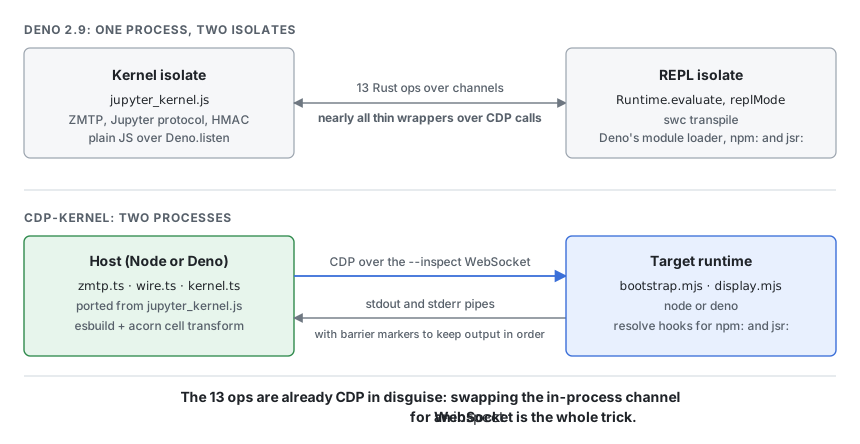
The 13 ops are already CDP in disguise, so swapping the in-process channel for an --inspect WebSocket is the whole trick.
The extraction: cdp-kernel
The spike was about 2,350 lines of TypeScript and plain ESM, plus about 1,500 lines of tests. It now lives in its own repository, tlockney/cdp-kernel, at about 6,900 lines plus 5,700 lines of tests, and is published to npm and JSR as @tlockney/cdp-kernel. The host runs on Node 24+ with native type stripping (22.18+ since 0.6.0), or on Deno when installed from JSR. Its runtime dependencies are still esbuild and acorn (with acorn-walk). The kernel host and the target runtime are separate processes:
- The host speaks Jupyter to the frontend.
- The target runs your code.
- The target is launched as
node --inspect=127.0.0.1:0 runtime/bootstrap.mjsordeno run -A --inspect=… runtime/bootstrap.mjs. The same bootstrap file loads unchanged in both.
What was ported, what was new
- Ported almost line for line:
- the ZMTP greeting, READY command and framing, keeping Deno's hard-won libzmq interop fixes;
- HMAC sign and verify, dropping forged messages;
- the shell, control and stdin handlers;
- completion via
getPropertiesandglobalLexicalScopeNames; - the
is_completescanner and the codepoint/UTF-16 cursor maths; - the whole display formatter, covering DataFrames, Vega, images, HTML/SVG elements and the display symbol.
- Replaced: swc became esbuild (TS, TSX, enums, JSX, with a TS fallback for
<T>x) plus an acorn pass that rewrites imports,import()andimport.meta. On Node, Deno's module loader became amodule.registerHooksresolver: it re-parents cell imports to the notebook directory and addsnpm:(install on first use, one npm alias per range) andjsr:(mapped ontonpm.jsr.io). - New:
- the two-session interrupt;
- the pipe/WebSocket ordering barrier;
- synchronous
prompt()across a process boundary; - crash guards;
- a
Deno.jupyterproxy on Deno targets; - an opt-in
Denocompatibility namespace on Node.
- Added since the spike (each has its own issue):
- Jupyter comms and anywidget-style widgets, on every target (#9);
inspect_requesttooltips andhistory_request(#10);- typings for the
jupyterglobal (#11); - a notebook's
deno.jsonimport map, JSX settings andnode_moduleson Deno targets (#13); - an opt-in lockfile and serialized installs for
npm:/jsr:(#14); - JupyterLab's visual debugger on Node and Deno targets, over CDP's
Debuggerdomain (#18); - Bun, workerd and celld targets (#7, #8, #25), and Workers project bindings in
env(#26); - on Node,
.ts,.tsxand.jsxfiles imported by a cell compiled with esbuild when Node's own type stripping can't run them (#73, #91).
Runtime integrations explains the host/target split and how each runtime is driven, with diagrams.
The four problems that weren't mechanical
Each was found by probing and fixed in the spike.
| Problem | What happens naively | What cdp-kernel does |
|---|---|---|
| Imports | Code evaluated through the inspector has no module referrer. Node rejects import() with "A dynamic import callback was not specified". | Rewrites static imports to var x = (await __cdpk.import("m")).x, and routes import() and import.meta through a function defined in the bootstrap module. A resolve hook re-parents those imports to the notebook directory. |
| Interrupt | While a busy loop runs inside a Runtime.evaluate dispatch, the inspector processes no messages on any session, so terminateExecution is never seen. This was tested on both Node and Deno. | Each cell first awaits one macrotask, so user code runs as an ordinary task. terminateExecution then arrives on a second CDP session. The host abandons the dead evaluate, and state survives: a test counter kept about 466M increments across the interrupt. |
| Output order | console.log travels on a pipe and display() on the WebSocket, so "after" text overtook the display. This was the first e2e failure. | A numbered barrier marker goes to both pipes before each display message. The message waits for both markers, and later output waits for the message. |
Sync prompt() | The target is a separate process, so it can't block on the host's stdin channel. | The target sends input_request through a CDP binding, then blocks on readSync of its own stdin. The host writes the reply as one JSON line. |
The Deno namespace
On a Deno target, Deno.jupyter is a non-configurable getter that throws outside deno jupyter. The Deno global itself is configurable, though, so the bootstrap swaps in a Proxy that answers jupyter and forwards everything else. Existing notebooks run unchanged, and a jupyter global is available everywhere.
On Node, --deno-compat installs a separate kernelspec (cdp-node-deno). It provides a Deno namespace covering:
jupyter,versionandbuild;env,args,cwdandchdir;- text and binary file I/O, with Node errno codes mapped to
Deno.errors.*; readDir,stat,mkdir,remove,rename,realPath, and temp files and directories;inspect,stdoutandstderr.
Why opt-in
Libraries detect Deno with typeof Deno !== "undefined". With a shim present they take their Deno code paths, which may call APIs the shim doesn't cover (Deno.serve, Deno.Command, Deno.openKv). APIs outside the shim are simply absent, so feature checks still return false instead of throwing. Turning it on by default is a one-line change if that trade suits you.
Evidence
The e2e suite drives the kernel through Python's jupyter_client, which uses pyzmq and therefore real libzmq, so a pass also proves the pure-JS ZMTP interoperates. It follows Deno's tests/integration/jupyter_tests.rs and adds the gaps those tests leave. Kernelspecs go into a temporary JUPYTER_DATA_DIR.
Revised: the suite has grown from 28 checks on two targets to 275 across every target, and CI runs it on Linux and macOS against Node 24 and 26 and Deno 2.9 and the latest 2.x, eight combinations in all (as of 2026-10-16; CI has tested Node 22 too since 0.6.0). One combination also runs it against the packed npm tarball and against the host running on Deno, the two ways the kernel ships.
Conformance suite, CI on main, 2026-10-15 (Ubuntu, Node 26, Deno 2.9):
| Kernelspec | What it adds to the shared checks | Checks |
|---|---|---|
| node | Protocol, language, display, modules, prompt, interrupt, completion, inspection, history, comms and widgets, debugger breakpoint, npm:/jsr: and the lockfile | 39/39 |
| deno | As node, plus Deno.jupyter === jupyter and the Deno.* file APIs; Deno's own lockfile instead of cdp-kernel's | 40/40 |
| node + compat | As node, plus the Deno namespace shim | 41/41 |
| deno, in a Deno project | Import map aliases, JSX import source, project node_modules; a broken deno.json warns once | 14/14 |
| bun | Shared checks without the debugger; interrupt of an awaiting cell keeps state, a busy cell restarts Bun | 39/39 |
| workerd | Shared checks without the debugger or stdin; request-scoped APIs, fetch, I/O objects that carry over between cells | 41/41 |
| celld | As workerd | 41/41 |
| workerd and celld, in a Workers project | Project bindings in env, a Durable Object stub across cells, the project's own worker.fetch | 20/20 |
| Total | 275/275 |
Counts include the shutdown check. The same 275 pass on main on 2026-10-16. The unit suite has grown from 112 to 322 tests (310 at 0.4.0), covering the original areas plus comms, widgets, the debugger, source maps, introspection, history, the lockfile, Deno project config, and each of the Bun, workerd and celld backends. tsc --strict is clean. A separate CI job drives JupyterLab in Chromium through Playwright to check that widgets render and round-trip in a real frontend on every target, and that the visual debugger works on Node and Deno.
The spike's original table, from the first run on 2026-10-14: 26/26 checks on Node, 28/28 on Deno, 28/28 on Node with the compat namespace, and 112/112 unit tests.
A real Deno-style notebook
examples/deno-style.ipynb is written against deno jupyter's APIs. It uses import pl from "npm:nodejs-polars@0.18.0" DataFrames, which are a native N-API addon, plus a filtered and derived frame, a Vega-Lite v5 chart object, a Deno.jupyter.svg badge, a progress bar updated in place via display_id, a class with Symbol.for("Jupyter.display"), and Deno.makeTempDir/writeTextFile/readDir. Executed by nbclient, it produced the same output types cell for cell on the Deno target ("Running on Deno 2.9.6, V8 15.0") and on the Node target with the shim ("Running on Node 26.8.1, V8 14.6"). The executed copies sit next to the source notebook. A second example, examples/moma-collection.ipynb, adds jsr: imports, Observable Plot, widgets and server-rendered HTML, executed on Node and on Deno. Both are on the docs site with their real output: A Deno-style notebook and MoMA's collection.
Options compared
Seven routes, ranked by how much of the Deno experience they keep for the effort, and by how well they survive Deno going quiet. Revised: the status and effort columns now show what was built; the ranking is unchanged, and celld is added. Choosing a runtime compares the targets for day-to-day use.
| Route | Status | Fidelity to deno jupyter | Effort from here | Durability |
|---|---|---|---|---|
| cdp-kernel, Node target | Released in 0.1 | High: TS, npm:/jsr:, display API, interrupt, stdin, widgets, debugger. util.inspect formatting | Maintenance; Windows (#32) | Node and V8's inspector, both long-lived |
| cdp-kernel, Deno target | Released in 0.1 | Highest: Deno's own loader and project config, permissions model off, real Deno.* | None beyond the above | Rides the frozen runtime: 2.9.x LTS fixes until October 2027, then a fork's |
| cdp-kernel, workerd target | Released in 0.3 | Medium: cells hoisted onto globalThis; a busy-cell interrupt restarts workerd; no debugger or stdin | Maintenance | Cloudflare's stated direction |
| cdp-kernel, celld target | Released in 0.3 | Medium: as workerd, without --experimental | Maintenance; celld is young (0.6.2) | Depends on celld's future inside workerd |
| Bun backend | Released in 0.3 | Medium: cells hoisted onto globalThis; a busy-cell interrupt restarts Bun; no debugger or compat namespace | Maintenance | Depends on Bun |
| rusty_v8 native host | Assessed (below) | Whatever you rebuild | Large: event loop, module loader, web APIs, inspector wiring | rusty_v8 is supported; the rest is yours |
| Native FFI shell (runtimed) | Assessed (below) | Transport only | Medium, and it solves a solved problem | Good, but unnecessary |
| Adopt tslab or IJavascript | Survey | Low: no Deno display API, no npm:/jsr:, old TS | Fork and modernize | Stale since 2024 and 2021 |
The ranking turns on one fact. Deno already did the separation, and the seam it chose (CDP) is a public, multi-vendor protocol. Every route that keeps that seam inherits Deno's REPL semantics almost for free. Every route that drops it has to rebuild them.
workerd as a target
The probe ran workerd 2026-09-30 (npm workerd@1.20260930.1) with --inspector-addr and --experimental, and gave the worker an UnsafeEval binding. It compared inspector evaluation against evaluation inside a fetch handler.
| Capability | Inspector Runtime.evaluate (no request) | Inside a request (UnsafeEval) |
|---|---|---|
| replMode, const redeclare, resolved top-level await | Works | n/a (function body; needs hoisting) |
eval / new Function inside a cell | Works | Works via binding |
Dynamic import(), CDP addBinding | Works | — |
Timers, fetch, crypto.randomUUID | Fails: "Disallowed operation called within global scope" | Works (fetch needed an outbound network service allowing private addresses) |
| Globals persist between cells | Yes | Yes, across requests |
| Interrupt via second session | No reply; the first session then stopped responding | Untested (CPU limits are the likely lever) |
A notebook needs timers and I/O, so a workerd backend has to run cells inside a request. workerd marks that context with an IoContext.
The design that follows from the probe:
- A driver Worker exposes
POST /eval. - The host hoists each cell's top-level declarations onto
globalThis(the tslab technique) and runs it throughUnsafeEval.newAsyncFunction. - Display messages travel back in the response.
- The inspector is used only for completion.
That is a new backend behind the same host, not a change to the protocol half. If "rusty_v8 in workerd" eventually lets Rust code reach workerd's inspector or isolate directly, an in-process variant becomes possible. Nothing public yet says that it will.
What was built
Revised. The workerd target (#8, #26) kept the probe's core idea, cells evaluated through UnsafeEval inside a request with declarations hoisted onto globalThis, and changed the rest:
- One request, not one per cell. The host opens a single WebSocket to the driver Worker, and every cell runs inside that session's request. I/O objects, Durable Object stubs and pending timers then carry over between cells, which a
POST /evalper cell would not allow. The cost is that the request never ends, so Workers' per-request CPU and duration limits don't apply. - No inspector. Output and display messages come back over the session in order. The driver is served on a Unix socket in a private directory, opened with a per-launch token.
- Interrupt. A cell waiting on a promise is abandoned in place and state survives. A busy cell can't be reached, so workerd is stopped and restarts on the next cell, losing state.
- Workers projects. With a
wranglerconfig at or above the notebook, the driver runs on the project's own Miniflare, with its bindings inenvand itsmainasworker.
celld (#25) runs the same driver Worker over the same session. It allows a plain global eval, so it needs no --experimental, and it listens on loopback TCP rather than a Unix socket. workerd and celld describes the target as it works today.
Bun
Bun 1.4.0's --inspect speaks the WebKit Inspector Protocol. Probed directly:
Runtime.evaluateworks.constredeclaration is tolerated even withoutreplMode, because of JSC's console semantics.- Top-level
awaitis a SyntaxError. awaitPromiseis ignored.Runtime.addBinding,globalLexicalScopeNamesandterminateExecutiondo not exist.
A Bun backend would therefore evaluate in-process: wrap cells in async functions, hoist declarations, report output through a socket back to the host, and interrupt by restarting the process. The host, wire protocol, transformer and display module carry over unchanged.
Revised. The Bun target (#7) was built this way, with two refinements. Host and target exchange JSON lines over a pipe on fd 3, which only the host holds, so there is no port at all. And interrupt only restarts Bun for a busy cell; a cell waiting on a promise is interrupted in place and keeps its state. The hoisting has visible edges: a top-level const can be reassigned, and declaring a global's name replaces that global instead of shadowing it. Bun describes the target as it works today.
rusty_v8 and FFI surfaces
Probed on the study's machine. Deno.dlopen (Deno 2.9.6) and bun:ffi (Bun 1.4.0) both loaded libSystem and called getpid(). Node 26.8.1 has a node:ffi module only behind --experimental-ffi. Without the flag, it is an unknown built-in, so the research sweep's "on by default" was wrong for this version. With the flag, dlopen worked. So one C-ABI library can be loaded by all three runtimes.
What FFI can't do is the important part. A kernel's evaluator has to run code in the host runtime's own isolate. A cdylib that links rusty_v8 brings a second V8 with its own heap. It cannot see the host's globals, modules, or node_modules. FFI is useful only for the transport, and the transport is already solved in pure JS. runtimed's pure-Rust jupyter-zmq-client (reported by the sweep, not opened) is a good reference implementation, but it isn't needed.
rusty_v8 as the base of a standalone kernel binary is coherent but expensive. The v8 crate has complete inspector bindings. You would still build an event loop, a module loader with TS transpile and npm: resolution, console, timers and fetch, which is most of what deno_core is. deno_core is still shipping releases (0.412 in September, per the sweep), but nobody has committed to its future. The CDP route reaches a richer result by borrowing an existing runtime instead.
Where Rust would earn its keep
A single-binary, dependency-free kernel host: ZMTP plus the Jupyter protocol in Rust, driving any CDP target. That's a packaging choice, not a capability gain. It's worth doing only if shipping a Node-based host becomes the obstacle. Revised: the host now also runs on Deno, installed from JSR, and that obstacle hasn't appeared.
Risks and gaps
Revised. The original list, with what happened to each item:
- No comms, so no ipywidgets. Resolved (#9): comms work on every target, with anywidget-style widgets through
jupyter.widget. The classic ipywidgets controls are Python classes, so they remain unavailable. - Formatting differs on Node. Kept, deliberately (#17): each runtime's users see the format they expect. On a fixture of 30 typical values, 23 format identically on Node and Deno; the rest differ in string quotes and Node's loader frames in stacks. A test fails if a new kind of difference appears.
- Node
npm:is simple. Partly resolved (#14, #39, #40): an opt-in lockfile pins exact versions, and installs are serialized. The cache is still shared, so peer dependencies resolve by real name, and a project'spackage.jsondoesn't decide annpm:import's version. - Two processes. Unchanged. The inspector is now private to the host, and the workerd and celld sessions are opened with a per-launch token.
- The interrupt recipe relies on observed V8 inspector behaviour.Pinned: CI checks it on every combination of Node 24/26 and Deno 2.9/latest (#15), and on Node 22 since 0.6.0.
- Deno targets use
--node-modules-dir=none. Resolved (#13): a Deno target honours the notebook'sdeno.jsonand projectnode_modules. - Not done: type checking and WebGPU display remain undone. Done: the debugger (#18), on Node and Deno only, and
inspect_requestcontent (#10), from runtime values rather than TypeScript types.
New since the first compile:
- Weakly held inspector promises. With
replModeorawaitPromise, V8's inspector holds the result promise only weakly until its callback runs, so a GC in that window fails the call with "Promise was collected". It broke Deno target startup intermittently (#50, fixed by using plain evaluates there). Resolved (#55): cells end by yielding one macrotask, so the promise settles before anything else can run; synchronous helpers dropawaitPromise, async ones return a promise the target holds, and side-effect-free lookups use plain evaluates. - The in-process backends are less faithful. On Bun, workerd and celld, a busy-cell interrupt restarts the runtime and loses state, top-level declarations are
globalThisproperties, and only a trailing expression shows a result. - workerd needs
--experimentalforUnsafeEval, and its cells share one request that never ends, so production limits don't apply. A Workers project'smainis bundled with esbuild directly, not with wrangler's build. - Windows isn't supported (#32). Unit tests were made portable and
npm:installs now run throughcmd.exe(#51), but the workerd target needs Unix sockets, the e2e suite has never run there, and celld has no Windows build. There is no Windows CI job, so the rest waits for a way to test on Windows. - The Deno target is frozen (added 2026-10-16). Deno 2.9 gets fixes until October 2027 and no features. That is good for stability now, and a question for later: past October 2027 the Deno target depends on a fork. The Node target, which runs the same notebooks with
--deno-compat, is the long-term home. - Little real-world use yet. The suites are broad, but the kernel is new.
Known gaps keeps the current list of limits.
Recommended next steps
Revised. Four of the five original steps are done:
- Promote the spike to its own repo and publish it to npm and JSR. Done:
tlockney/cdp-kernel, released as@tlockney/cdp-kernel0.1.1 through 0.4.0 with npm provenance. - Ship typings for the
jupyterglobal. Done (#11). - Add comms, so ipywidgets and anywidget work. Done for anywidget (#9). The kernel now does something
deno jupyternever did. - Offer it upstream. No one has claimed the Jupyter kernel in denoland/deno#36995 or the forks. A runtime-neutral kernel is useful to all of them, and it keeps working whichever fork wins. Open (#16).
- Only then consider the workerd hybrid backend or a Bun backend. Done, ahead of step 4: Bun, workerd and celld targets (#7, #8, #25).
What's next from here (revised 2026-10-16):
- Offer it upstream, as above (#16). Deno's LTS announcement doesn't change the pitch:
deno jupytergets fixes, not a successor. Close the weak-promise exposurein cell evaluation, comms and the debugger. Done (#55).- Get real notebooks run on it, and treat what breaks as the next priority list. The fixes for imported TypeScript on Node (#73, #91) came this way.
- Windows, if users ask for it and it can be tested (#32).
- Plan for the Deno target after October 2027. Keep Node with
--deno-compatable to rundeno jupyternotebooks, and follow which fork, if any, carries the runtime on.
Where it landed
Added 2026-10-15, revised 2026-10-16. How the study's predictions held up:
| Prediction | Outcome |
|---|---|
| The protocol half and display API port cleanly; CDP is the seam | Held. Node and Deno targets share one bootstrap, and the host now also runs on Deno. |
| Interrupt via a second CDP session keeps state | Held on every CI combination of Node 24/26 and Deno 2.9/latest, and on Node 22 since 0.6.0. |
| workerd needs a request-scoped hybrid backend | Held. Built with one long-lived request instead of one per cell, so I/O carries over between cells. |
| Bun needs an in-process backend; host, transformer and display carry over | Held, as described under Bun. |
| Comms are the largest missing protocol feature | Built on every target, with anywidget-style widgets checked in JupyterLab. |
| Formatting differences on Node are small | Measured: 23 of 30 typical values match; kept as is. |
| The remaining risks are known | Not quite. V8's weakly held inspector promises (#50, #55, both fixed) and Windows (#32) weren't foreseen. |
| The Deno runtime gets about a year of fixes, then development ends | Confirmed and dated: 2.9.x LTS until October 2027, no new features (denoland/deno#37030). |
| Bun and workerd backends are optional extras | They were built anyway, plus celld, which the study mentioned only as part of Cloudflare's plans. |
The verdict stands: extract the JS halves and drive the runtime over CDP, with in-process backends where a runtime can't be driven that way.
Glossary
- BYONM: Bring Your Own
node_modules: Deno's mode where npm packages resolve from a localnode_modulesdirectory managed by another tool, instead of Deno's global cache. - Barrier marker: An escape-delimited sequence number the target writes to both stdout and stderr before each display message. The host releases the message only once both pipes reach it, and holds later pipe output until the message is out.
- CDP: Chrome DevTools Protocol: the JSON-over-WebSocket protocol V8 runtimes expose through
--inspect.Runtime.evaluate,Runtime.callFunctionOnand friends let an outside process run code in the runtime and inspect the results. - cdylib: A Rust crate compiled as a C-compatible dynamic library (
.dylib/.so/.dll) that any FFI layer can load. - IoContext: workerd's per-request context. Timers, fetch, random values and other I/O are only allowed while one is active; code running at global scope, including inspector evaluations, has none.
- kernelspec: A
kernel.jsonfile in a Jupyter data directory telling frontends how to launch a kernel: argv with{connection_file}, display name, language, interrupt mode. - replMode: A
Runtime.evaluateflag in V8's inspector that gives console semantics: top-level await, andlet/const/classdeclarations that can be redeclared in later evaluations. - ZMTP: ZeroMQ Message Transport Protocol: the wire format ZeroMQ sockets speak over TCP. Jupyter frontends use it for all five kernel channels. Deno implements the NULL-security subset in plain JavaScript.